
Why Beginners Quit Freelancing in the First 3 Months (And How to Avoid It)
Freelancing will continue to be one of the best ways to earn money online in 2026. Each day, many thousands of new freelancers are entering places like Upwork, Fiverr and Freelancer with high hopes for achieving their financial independence, watching YouTube videos, creating a profile and submitting proposals.
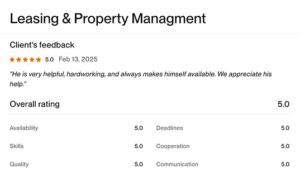
I have been managing properties for the past 4 years, and these are my customer reviews
However, statistics show that the vast majority of these new freelancers will quit freelancing within three months.
Why does this occur?
It’s not that freelancing is a bad thing. It’s because beginners encounter genuine problems for which no one provides a proper explanation.
In this article, we’re going to explore exactly why newcomers fail quickly and offer practical solutions that you can use to stick to it, get customers, and finally succeed.
Unrealistic Expectations
The Problem
Many newbies think freelancing is a way to make “fast money”. They expect to land their first client within a few days.
But when they don’t get quick results, they’ll lose interest and give up.
The Reality
Freelancing isn’t fast. It takes time to:
- Build trust
- Improve skills
- Understand client needs
- Optimize your profile
The Solution
Establish a realistic timetable (30–60 days for first client)
Focus instead of earnings on learning early on
Instead of looking for immediate outcomes, log daily hours worked
Sending Weak Proposals
The Problem
The majority of beginners use the same cookie-cutter proposals:
“I can do your work perfectly. Please hire me.”
These are usually ignored by clients.
Why It Happens
First-timers don’t know what clients really want …
Solutions, not promises
Understanding, not pleading
The Solution
Write proposals which address problems:
- Start with the client’s problem
- Show your understanding
- Offer a fast solution
- Provide some small proof or idea
For example:
Instead of:
I am expert in SEO
Write:
I noticed your website isn’t ranking due to poor keyword targeting. I can do this by optimizing your on-page SEO and improving the content structure.
No Skill Focus
The Problem
Beginners try to do a bit of everything:
- Graphic design
- Content creation
- Video editing
- SEO
This results in confusion and poor performance.
The Reality
Customers engage professionals to do one thing good instead of general beginners.
The Solution
Pick just one skill for the first 60 days:
- Content creation
- SEO
- Video editing
- Web design
- Then, every day:
- Try it out
- Build 3–5 sample projects
- Only concentrate on that field
- No Portfolio (Big Error)
Issue with Old Work
Individuals will ask you, “Can you give us some examples of your work in the past?”
If you’re new to your field, you won’t have any experience to show.
Therefore, you’re often not considered.
Resolution
You can create samples of your work even though you have no clients.
Make 2-3 demo texts;
Make logos for demo;
Develop a demo website.
What’s most important in working with clients is what you can do; not who your previous clients were.
Fearing Rejection
Problem
New freelancers, after sending 5-10 proposals, stop sending and wait quietly.
The feeling is, “I’m not qualified”, or “This is not for me while I’m not making any money”.
Fact
Even experienced professionals experience rejection.
Freelancing is a numbers game.
Resolution
Send out 10-15 proposals every day;
Do not consider rejection a personal reflection;
Learn from each proposal you send; and,
Be consistent in applying for projects instead of relying only on talent.
Lousy Optimized Profile
Problem
Most newbies have a profile like this:
Little or no title;
No or very weak description;
No portfolio;
Little or no specialization.
These mistakes reduce trust in you immediately.
Solution
Improve your profile:
Optimized Profile Tactics:
Effective Title: “Beginning SEO Blog Writer”;
Effective Profile Description
Who I work for:
Problem I solve for my client:
Result I provide for my client;
Add to your profile:
Sample Portfolio;
A professional profile photo;
Skill/Specific Keyword Focus;
Not Patient Enough
Problem
Most new people quit early into the freelance process.
After only attempting for 2-3 weeks, they quit.
Reality
The key to a successful freelance career is patience over a long period of time.
You can make it if you can show proof of your work. Keep the faith!
The Issue
Inexperienced individuals are learning inexperience through content and being provided with various approaches, making it challenging for them to discern what works.
Confusion arises from:
“Follow this path…”
“No, Follow that path!”
The Resolution
Select one method of approaching tasks and commit to it
An Example:
Choose one from:
- One platform (either Upwork or Fiverr),
- One skill
- One type of proposal to send.
- Stop overanalyzing and focus on taking action.
- Lack of Daily Structure
The Issue
Many Inexperienced individuals do not have a consistent daily routine.
Their actions are random; therefore, they are not progressing.
The Resolution
Create and follow a simple daily schedule:
- Freelancing schedule on a daily basis.
- 1 – 2 hours practicing your skill
- Send 10 (or more) proposals
- Develop your profile & portfolio.
- Learn from mistakes.
- The secret to success (consistency).
- Measuring Your Ability Compared to Others (what you see & think).
The Issue
New Freelancers see those who are successful and feel defeated
They think:
- “I’m not that good or experienced as they are”.
- “I can’t do this.”
The Reality
Everyone begins their Freelancing Journey the same way.
The Resolution:
- Focus on Your Own Freelancing Growt
- Track your progress with small achievements.
For example:
- Contacted 1st potential client,
- Scheduled your 1st interview,
- Secured your 1st client.
- Growing your Freelancing career takes time.
How to Stay with Freelance Work (A Guide with Steps to Take)
Here is your guide to develop a path of success when working as a freelance worker:
Step 1: Choose 1 Skill
Do not make multiple decisions; make only one decision and commit to it.
Step 2: Create 3 Examples of Work
Until you have demonstrated your success as a freelancer, you will need to have examples of your work to give to potential clients.
Step 3: Update your Profile
Your Profile will allow you access to new potential clients; therefore, you want to make certain that it is appealing and informative to clients attempting to find you to conduct work with them.
at least 3 times more of the same 4 times more than once.
Final Thoughts
Freelancing isn’t hard, it’s just requires patience, strategy, & consistency.
Beginning freelancers give up because they:
1) Expect quick results
2) Don’t know the process
3) Give up too soon
If you can avoid these mistakes your chance of success is at least 90% higher than most beginning freelancers.
Keep in mind:
– The first three months of freelancing are for building the base of your business, not for earning.
– With consistency & improvement your results will come.
FAQs
1. How long before landing your first freelance client?
If you consistently submit proposals & improve your skills, approximately 30–60 days.
2. Is freelancing saturated as of 2026?
There is a lot of competition, however, reliable & good freelancers always find work.
3. How many proposals should a beginner submit on a day?
10–15 high-quality proposals.
4. Can you freelance with no experience?
Yes, you can build/produce sample work to use for your portfolio.
5. What is the most common reason for beginner failure?
Patience and consistency are lacking.